The framework of frameworks

A mental framework is a shortcut for making sense of something. They can often help evaluate what to do in unfamiliar circumstances, or aid in predicting the future. They are always an attempt to simplify something complex in a useful way.
For example there's Occam's Razor: "The simplest explanation for something is often the right one." When trying to determine the cause of something confusing, this mental model steers people away from complex explanations in favor of simple ones.
Frameworks are distilled wisdom
While mental frameworks don't always yield correct analysis, they are often more useful than not having one.
The reason a mental framework has become famous or lasted through time is because they have stood up to many tests of their veracity.
Frameworks should be predictive
A mental model or way of thinking should be judged by whether it can predict the future accurately. If it's only able to explain the past and not predict the future, it's not a useful framework.
Frameworks are often in opposition to "First Principles Thinking"
The most reliably predictive framework is First Principles Thinking because the whole premise is to only rely on known physics to help make the decision.
First Principles Thinking will always lead you to truth eventually, but you may not have enough information or time to arrive at the truth.
That's why we use other mental frameworks as shortcuts when the wisdom of others can be relied upon. Even when they're not always as predictive as this one.
The framework to evaluate frameworks
All frameworks should be interrogated before they are something you adopt. They should be tested to see if they're predictive in your life and in the experience of others.
They should also be interrogated for when they're useful. This is how I evaluate them:
All frameworks are on a spectrum of applicability from "Universal" to "Specific." And then on another axis to plot whether they're always true or not.
There are some frameworks that always yield a specific concrete conclusion to a situation, but it's not always accurate or good recommendations.
There are other frameworks that always yield the truth, but do not always yield a quick or specific answer.
Each should be evaluated on whether they're a good framework or not. Here's a few examples from Elon side of the world.
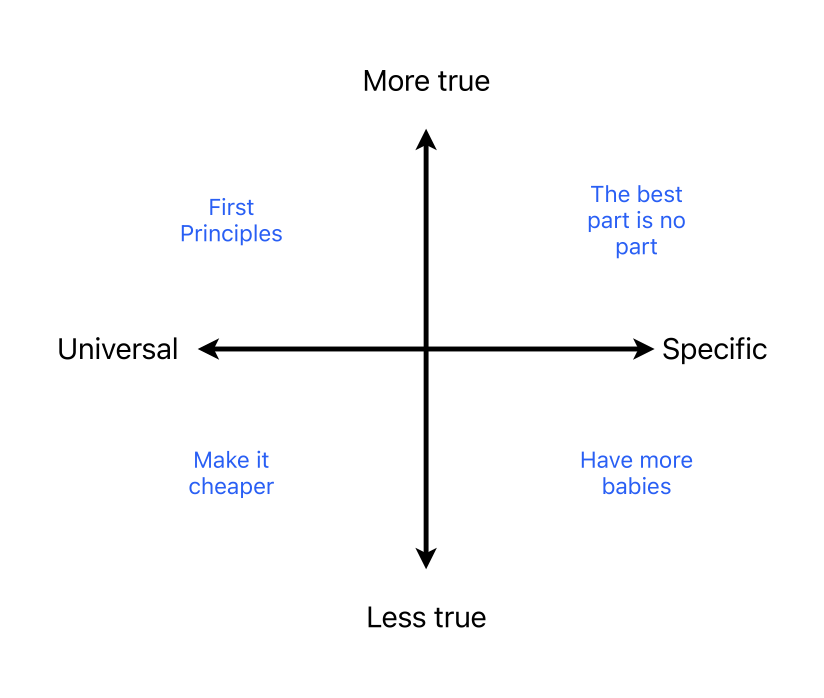
Universal and less useful: Solving problems by making them cheaper is fairly universally available as an option, but sometimes you need quality and cheapness could cause problems.
Specific and less useful: Having more babies isn't always applicable to the conversation ("sir this is a Wendy's"), and if someone already has 10, maybe it's actually not good advice.
Specific and useful: The best part is no part. Not all situations are about parts, but when it's relevant it's almost always true.
Universal and useful: As we discussed before first principles thinking will always yield the truth, and is applicable in all situations.
Collect useful frameworks
There is a third axis which is usefulness. They live generally in the top two quadrants, ideally the top left quadrant. Because universally applicable, and maximally truth seeking frameworks are rare they're valuable to collect and utilize.
Though sometimes even these frameworks aren't the most useful in a given situation. E.g. First principles thinking is very difficult to use on matters of meaning or relationship. You may have to compromise on what you call a "first principle" to start building towards a useful conclusion.
Another example is "discern what to do through prayer," always applicable, always leads to the truth. Sometimes it takes more time than you have so another mental model is more useful in that situation.
There are no perfect frameworks, but collecting a set of reliable ones can help clarify and accelerate decision making immensely. Leading to a higher quality life and less analysis paralysis.