How to (actually) topple a regime
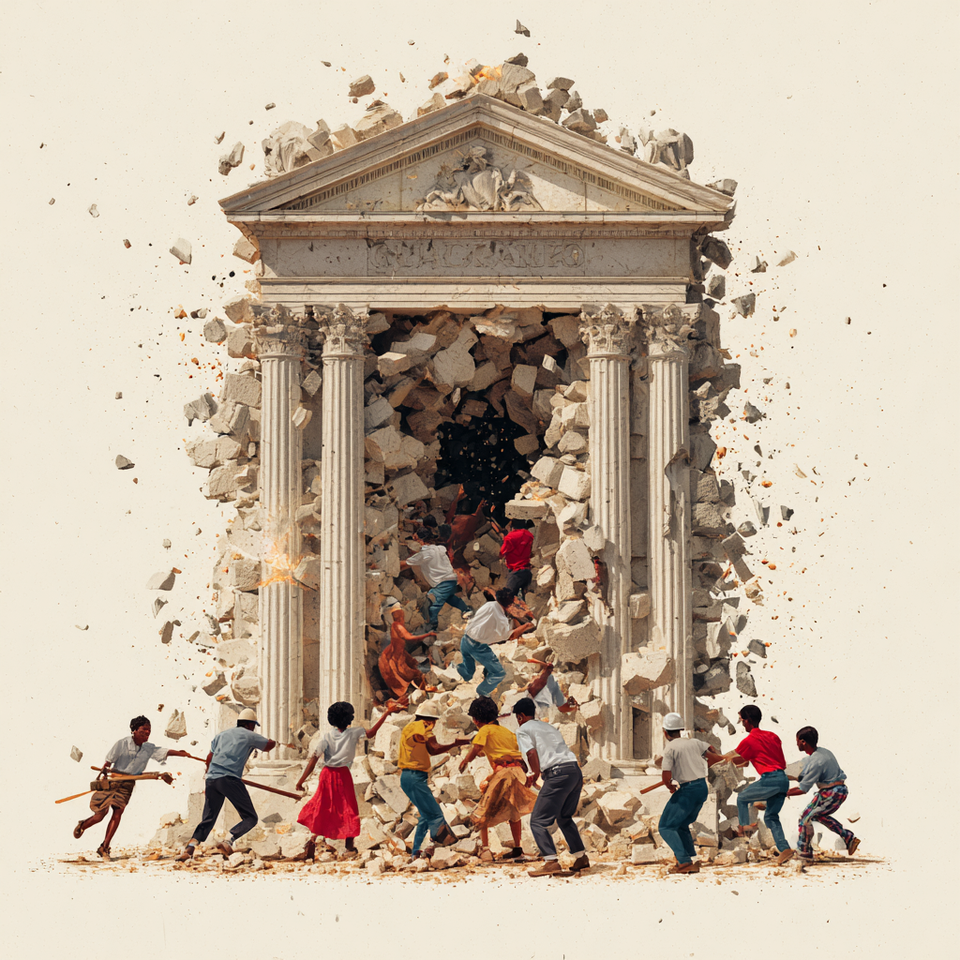
There's a lot of confusion of what is necessary for regime change, especially from my American friends. Let's talk about why mass protests are never enough.
No man rules alone
No matter how powerful or popular, no one can run a country alone. There's roads to build, a military to raise and equip, police to enforce laws, and lawyers to draw them up. The question of power is always "how do I ensure they obey?"
At the end of the day this question is answered via two important mechanisms: control the flow of taxes, and have all the guns.
Someone doesn't wanna pay taxes? Throw them in jail. They don't like that? Ok, we have the guns and you don't. End of story.
Someone protesting your actions or policies? Throw them in jail. They try to fight back? Cool, we have all the guns and you don't. End of story.
So long as those in power have the guns, they can collect the taxes, meaning they can pay the paychecks of the guys with guns. Doesn't matter if they're called "police" or the "revolutionary guard" or "FBI," if they're allowed to shoot their own citizens that's how control is maintained.
The myth of protesters storming the palace
In the modern era, a few dozen men with automatic weapons can hold off a nearly infinite stream unarmed assailants. That's not even counting drones, cruise missiles, or anything else.
Even the poorest dictatorial regime can protect their palace from an unarmed mob.
When an "unarmed mob" "arrests" the dictator, it's because the military or their personal guards defected. There are many scenarios that lead to this kind of situation, but regimes fall when the armed people say they fall.
The way regimes actually fall
Conquest
When the military is fully defeated, the victors can annex the territory directly or set up a new government. There's not much difference because even during annexation a "governor" is usually appointed.
For example: when Germany invaded countries in WWII it would set up friendly governments to govern the area according to Nazi interests, sometimes with local collaborators at the head.
Another example is when the US defeated Germany and Japan in WWII, we forced constitutions on them and replaced their governments with democratic ones.
This has profound affect on the citizenry depending on what is put in place.
Collapse
When the government no longer has the ability to impose a monopoly on violence, then you get lawlessness. Examples are Somalia, Sudan, etc. No one group has enough power to defeat all others. This can happen due to a decapitation strike (e.g. Libya) or civil wars (e.g. Somalia).
This always hurts the (former) citizenry.
Coup
When a faction in the government gets strong enough they may kill or remove the incumbent faction and install themselves in the places of power instead. Sometimes this is natural from real internal factions.
This can mean one dictator taking over for another dictator. This can mean a foreign force aiding one group to take over for another. This can also be duly elected leaders chipping away at the constitutional rights of citizens until they seize unchecked power.
This usually doesn't create positive change for the citizens, it's mostly aimed at changing a government's foreign policy and/or changing which elites are in charge and get the riches.
Revolution
When enough of the citizenry are fed up with the way things are, then sometimes they are able to overthrow the regime.
Often triggered by some violent act, new public policy, or sudden change in economic fortune, revolutions often feel sudden.
Usually there's a rebel faction (or multiple) that's existed for some time, but has not been eradicated. Usually because they're hard to find or hard to kill. Then when the iron is hot (due to the aforementioned flash point) they amplify popular unrest into a full scale threat to the regime.
If successful, the rebels put themselves in charge.
If they're semi-successful, the country collapses into civil war (usually ending in the collapse scenario above).
If they're unsuccessful, they are eradicated or pushed back into hiding to try again another time.
How easy will this be?
Centralization of power
Countries like Venezuela and Iran are set up for the guy at the top to control literally everything. They control the guys with guns (police and military), they appoint the folks who collect the taxes, they approve the candidates for who can run for office to make the laws.
In these situations, these regimes are more vulnerable to a decapitation strike. Either by rebels or foreign powers, it's much easier to topple regimes with centralized power.
Democratic countries aim to decentralize power to protect citizen rights, but this also has the effect of making regime change via decapitation strike rather difficult.
Succession planning
Even in an authoritarian regime, you can prevent easy regime change by having a clear line of succession for all key aspects of the government.
In the case of Cuba and China, the communist parties are in complete control of all aspects of the government and through that the economy. The real power struggles happen within the party structure.
This is a great way to ensure robustness in case of attempted decapitation strikes. If you kidnap Xi, China will just appoint a new chairman. This may weaken a regime in the long run if that key leader was incredibly competent, but the regime won't change.
Democratic countries often have robust succession planning, and in the worst case will just hold elections to replace the whole politician class as needed.
Existing opposition forces
If a regime falls, there's still the question of who takes over. It's far easier to change a regime if there's a rival regime waiting in the wings.
If a country is democratic enough to have opposition leaders, then regime change is more likely to work, because there will be a credible alternative to the regime ready to take over. (Venezuela)
If a country isn't very democratic but there are rebels in exile, they can triumphantly return with all the systems necessary to take control and change the regime. (The Shah of Iran)
But if a country isn't democratic and has eliminated opposition, regime change is far harder. (China)
How democratic are things?
If a country is fairly democratic, then often the easiest way to affect substantial change is to get people to vote for it.
If the goal of the citizens, or foreign forces for that matter, is to affect change in what the government does. It's usually easier to propagandize the public into voting for that change than to change the regime.
So... How do you topple a regime via revolution?
Protests are just harsh words at the end of the day. Unless they disrupt the regime in ways that threaten their control of the country, protests will affect nothing.
Working backwards
For the regime to actually fall: the current elites in the regime, who control the flow of taxes and command the people with guns, have to flee or change sides.
For that to happen momentum has to be on the side of the rebels. This usually becomes obvious once government buildings are burning or are taken over. Or when military installations are overrun or change sides. Or when military equipment ends up in the hands of the rebels.
Protests -> rebellion
For any real threat to the regime to manifest, protests have to turn into organized rebellion.
There must be some in the masses who are willing to storm government buildings, fight the police, find or steal weapons in order to start taking resources away from the government.
Usually there are pre-existing groups that are ready and willing to take this on, but they usually don't commit until protests turn ugly. Or they are emboldened when symbols of the regime are destroyed by protesters without consequence.
The cruel calculus of the dictator
If the dictator sees a mass protest start to turn into a rebellion, they will kill as many citizens as it takes to disperse the protests. As long as there are enough citizens to staff the factories, mines, oil rigs, the ranks of their army, they will continue killing.
The ONLY real deterrent against mass murder is that most dictators rely on their own citizens to be their guys with guns. Most soldiers will eventually defect if they are directed to continually commit mass murder of civilians.
Rebellions only succeed when their resolve isn't broken by the mass murder of their fellow rebels, before the defections begin.
Defense against defection
The dictator signs the checks of those with guns. That gives the dictator a lot of influence over the guys with guns. But there comes a point where even a hardened soldier cannot bear to continue shooting their neighbors.
This has been a problem for as long as humans have built governments of any kind. Kings solves this in Europe by hiring Swiss mercenaries to be their personal guard. Mercenaries are only motivated by money and have no neighbors in sight.
More recently governments used indoctrination and ideology to make sure that the guys with guns were rapidly aligned ideologically with the regime. Making them more willing to shoot their fellow countrymen despite the horror in it.
Iran currently has hundreds if not thousands of foreign militias augmenting their military and police in an attempt to keep control. It's much safer to have those folks shoot the Iranian people than have the IRGC do it.
This is also why once protests become rebellion the regime cuts of the internet. That way there are no viral videos of dead children to galvanize the rebels and convince the guys with guns to defect.
External pressure
No country can operate without some amount of trade. Every country that has tried has failed. This is usually more true with authoritarian regimes because they usually botch their economy.
So if a country's trade partners start to sanction them because of what they're seeing on social media, or the resources their trade partners buy from the regime start to burn (oil infrastructure in Iran for example), these trade partners may start to cut the regime off.
This doesn't usually have an immediate affect, but it's a huge loss to the viability of the regime's ability to continue fighting and recover afterwards. Sanctions from allies usually precipitates the elites fleeing with what they can stuff in their private jets.
Sanctions from allies who are also authoritarian regimes is less effective, as they're not responsive to their own citizens who may be outraged by the mass murder they see. Sanctions are most effective when the authoritarian regime is reliant on selling something to democratic regimes (e.g. Russian gas to Europe)
Foreign intervention
Foreign intervention can help the rebels, or hurt them. If the US were to openly arm a rebel group whose whole schtick is hatred of American imperialism, then that that intervention won't help the rebels succeed. In fact it's an easy way to discredit them and disperse them.
If the rebels aren't strong enough or popular enough to be the new regime after the old regime falls, then foreign aid may just result in a quagmire for the foreign power who may have to step in as an occupying force (Iraq after Saddam fell).
Foreign intervention is most helpful in ways that are more subtle. The US airdropping Starlink and solar+battery kits into Iran helps them organize and get out the images that will help galvanize internal and external support.
Galvanizing symbols
Symbols are powerful. Any successful rebellion has memes that galvanize the right kind of support at the right time.
Symbols that trigger protests Whatever the flash point is, there's usually some viral video or picture that encapsulates why people are so mad about the status quo.
This can be the video of George Floyd having the officer's knee on his back. This could be photos of the scars on a woman beaten for not wearing a hijab.
They do not create the anger, they just aggregate it into one angry voice. Triggering protest.
Symbols that embolden rebellion Once protests are persistent, the revolution needs people to truly rebel.
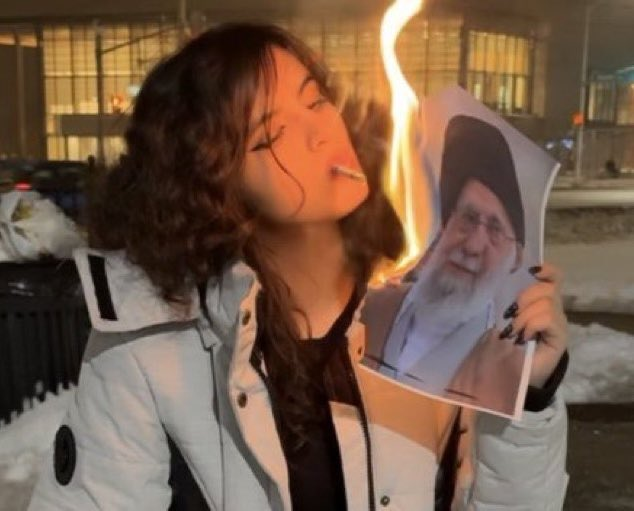
This can be a picture of a dead, non-violent protester. This can be photos of people desecrating the symbols of the regime. Anything that motivates people to start taking action.
These symbols come about at the time that is needed to turn protests into a real threat to the regime.
They don't even have to be real. The one below is an Iranian woman in Canada burning that photo, but most people think she's stunningly brave doing this in Iran. Doesn't matter, it worked.
Symbols that motivate defection These are the photos and videos that make the guys with guns change sides, which is necessary towards the end.
These are the horrific photos of dozens of bodies in the street, shot down by security forces. They are video evidence that key military or government installations are falling to rebels. They motivate people to join the winning side.
The key to revolution is reach Without Castro's access to radio, Iran's access to the social media, etc, revolutions will not have its symbols, its memes, that are necessary to continue and end the fight.
Timeline of a (successful) revolution
- Rebels or rebel factions lying in wait for years.
- A flash-point event (currency collapse, a viral video spreading about an episode of violence, etc).
- Mass protests that escalate for days or weeks.
- Protests turn into rebellion. Often this is when symbols of the regime are desecrated without reprisals: burning flags, burning effigies of the leaders, pulling flags or statues down, etc.
- Rebel factions organize direct action that threatens the regime (taking government buildings, seizing weapons depots and military outposts)
- A final push on the last remaining elites leads to their capture or flight into exile.
All the while the regime will ramp up killing and imprisoning citizens. If they're able to overcome the will of the rebels then the regime wins. If the rebels can maintain resolve and continue to gain ground the rebels win.
A rebellion without someone who understand memes will not have the resolve to overcome the dark days of mass murder.
So...How do you topple a democracy?
Force your politician's hands
The easiest way is to not. Usually the easiest way to get what you want is to get politicians to give it to you.
The best way to do that is to convince them that if they don't they won't be re-elected.
The best way to do that is to protest, organize a primary, and get people to donate to their opposition.
If voting isn't working
If you're in a democratic country and the politicians continue to ignore the will of the people, even when you vote in new people who promised to do what you want. Then you know that you're not a democracy anymore.
That's when you may need a revolution. The nice thing about a rebellion within a democracy is that the door for the people in charge to change their minds is always open. They can just step aside and allow a rebel in their seat, or give in to popular demand.
If you're willing to play the long game
If you're a sufficiently motivated foreign or domestic faction who wants to make a democracy not a democracy anymore. Then you need only chip away at it slowly.
Force money into politics so that powerful interests have more say that people (Citizens United). Deploy the army to stop rioting to set "precedent" that it's OK to break the constitution (Bush Sr. in LA). Expand and/or pack the supreme court to ensure your interpretations of the law are what stand in court. Expand federal policing (ICE, ATF, etc). Take away people's rights to bear arms (why can't I own artillery again? Or night vision equipment? Or grenades? Or tanks?).
Maybe force people to take a untested medical treatment that ends up being extremely dangerous to set precedent about bodily autonomy (Covid). Maybe start taking ownership or revenue share in key industrial companies for the federal government to benefit "national defense" (Intel, NVIDIA, etc).
And polarize folks so much that they are perfectly fine with you violating the evil opposition's rights because they're Nazis or Commies or whatever.
Eventually someone will be able to seize on a crisis and centralize enough power that the democracy is gone.
Why the US constitution is special
When the US constitution is fully followed (big IF), the only reasonable way to change things is via the democratic process. This leads to an incredibly stable regime.
The constitution restrains the government, not you
If you'll notice the constitution only limits the government and politicians, not citizens. There is no "thou shalt not steal" or "thou shalt not party so loud at night thy neighbors can't sleep" in the constitution, that's up to the states and cities to decide.
The constitution restrains what can be accomplished by voting
Democracy is bad because it always leads to "two wolves and a sheep voting on what's for dinner." Constitutional republics, on the other hand, restrain what even popular politicians can do.
Civilian control of the military
The military is always the greatest threat to a regime because they usually roll up to one commander in chief, which means there's one person that could theoretically take out the regime. In the US, that person is a civilian: the president, the current head of the regime. This limits the capacity the military has to implement regime change unilaterally.
They're also not allowed to operate on US soil unless it's to repel foreign incursions. And they certainly aren't allowed to be deployed against US citizens, unless they're acting on behalf of a foreign power.
Police are local
The other guys with guns, the police, are controlled locally. The police are not federal, they're municipal, county, and state controlled. This limits centralization and control of the people who have the ability to effect regime change.
Voting is local
When you vote, it's not run by a federal system. Each state controls how voting is done and delegates a lot of that to the local level folks, many of whom are volunteers. This limits the centralization that could lead to voter fraud done by the federal government.
The right to bear arms
The other thing is that the US isn't a disarmed nation. At the end of the day, if the government has fully lost its way, our constitution actively says it's our duty to overthrow them. Our ability to do so is protected by the Second Amendment. We are encourage to keep and bear arms for this eventuality.
The right to assemble
Gathering in publicly owned spaces to protest or organize is constitutionally guaranteed. If government officials infringe on that right, it's grounds for their removal or recall. This means the people always have the right to show their support or opposition to policy in a way that (when persistent) often does change public policy in a republic such as ours.
Freedom of the speech and the press
The government cannot control your political speech. This is pretty radical and honestly no other country has this strong of a protection for speech.
Channels for taking speech and publishing it where people can consume it is also constitutionally guaranteed. The press must not be interfered with by the government either. This means political speech can always reach the ears of the people.
Political campaigns can be organized, ideas can be challenged, the powerful can be held accountable, and if need be: rebellions can be planned.
Due process and judicial review
If all that isn't respected or is unclear, we have a strong judiciary that can interpret the law and limit the government to what they are legally allowed to do.
Different from nearly ever other democratic country
The UK doesn't have a constitution like we do. They're a monarchy who has temporarily surrendered its power to a parliament. That parliament can revoke any citizen's rights by majority vote. Or the King could dissolve parliament and take control. That's why their institutions are still called "His Majesty's Royal Airforce" and "His Majesty's Customs and Revenue" (tax collection), etc.
Many other democratic countries are "republics" in name only, or are functionally just democracies as well. Meaning they're vulnerable to the whims of politicians.
In the US it's painfully difficult to change the constitution. Which is the ONLY way to take away rights guaranteed in the constitution.
It all works together
All of these facets of the constitution address failure modes or attack vectors that our Republic face when people conspire to change the regime.
If the constitution of the US is executed as written, people's rights are respected, the government cannot steal from its people, people are able to force politicians to evolve policy to suit their needs, and citizens are given every tool to prevent the regime from being changed by force (whether by elites or foreign forces).
What we have in the US is truly special and we need to rededicate ourselves to the constitutional protections that keep people safe, free, and able to build full and meaningful lives.
The Dictator's Handbook
I base much of this on this book which I highly recommend. And the "no man rules alone" comes from the video summary / restatement of that book from CGP Grey .